
Friday, August 28, 2015


Friday, August 16, 2013
Dwarf Minke Whales - Runners on the Ribbons
It's early July on Australia's Great Barrier Reef and the SE trades are roaring fit to blow dogs off chains.
However it's in that magical six weeks when the dwarf minke whales arrive on the Ribbon Reefs in force. Where they come from and then go to is still a mystery but Pam and I are fortunate to be with an expert scientific team on a specific world first minke mission. They have 4 satellite tags that will track these illusive pimpernels. But first the tags need to be applied.
We are on Curt and Micheline Jenner's state of the art research vessel, WhaleSong. Long term dwarf minke pioneers and researchers Dr. Alistair Birtles and John Rumney are aboard together with renowned telemetry expert Dr. Russ Andrews, and the man who will do all the hard work applying the tags, Jimmy White. The whales decide to cooperate and the tags are on in two days. Three of the whales hung around for another two days showing off their shiny new tracking gear.
Four weeks later, the minkes are well south with the lead whale about to enter Bass Strait on Australia's southern coastline. For more information go to www.cwr.org.au
Images: Pam and Wayne Osborn


 |
| A dwarf minke surfaces next to WhaleSong |
 |
| A dwarf minke neatly fitted with a 'limpet' satellite tag. |
Monday, October 8, 2012
The Orca Survivor

The extensive scars and missing blubber bear testament to a near fatal battle for this little one. Miraculously she has survived and is beginning to heal. The water would have been filled with blood as the pack of orcas fought to tire and drown here. The scarring and missing flesh on her fluke show where one orca has held her whilst the others attacked. Her mum would have been desperately engaged in the battle to save her calf.
The top two images show the calf's right and left flanks. The third image show her damaged fluke. The bottom image show's mum's right flank. She appears unscathed however there is an abrasion just below her dorsal fin.
Both cow and calf were resting when photographed by Pam Osborn. Exmouth Gulf is a shallow water resting ground for humpbacks and new season calves. Whilst Orcas work the outside waters of Ningaloo Reef (a number of calf fatalities have been recorded there in recent years), they don't often enter the waters of the Gulf.
Thursday, November 17, 2011
Life & Death in Perth Waters
As the remarkable recovery of humpback whales from, a few hundred on the Western Australian coast in the 1960's to over 30,000 today, continues new problems emerge. On 10/11/2011 a humpback calf was hit by a pleasure boat transiting between Fremantle and Rottnest Island. The calf sustained deep cuts to its back and was not expected to survive. The stress to the mother - a highly intelligent and sentient mammal does not bear thinking about. For the people on the boat, the experience would also be traumatic.
The above image is of a mother relaxing with her calf near the windmills (on the track from Fremantle to Rottnest) 8 days before the collision. We really haven't come to grips with the explosion of whale numbers in our waters. Pam and I have photographed over 1600 humpback whales in Western Australian waters and we see growing evidence of more frequent ship strikes.
It's time that we seriously rethink how we manage our marine activities and make our waters safer for these precious survivors from the days of commercial whaling. Unfortunately as on the roads, speed kills.
Tuesday, November 15, 2011
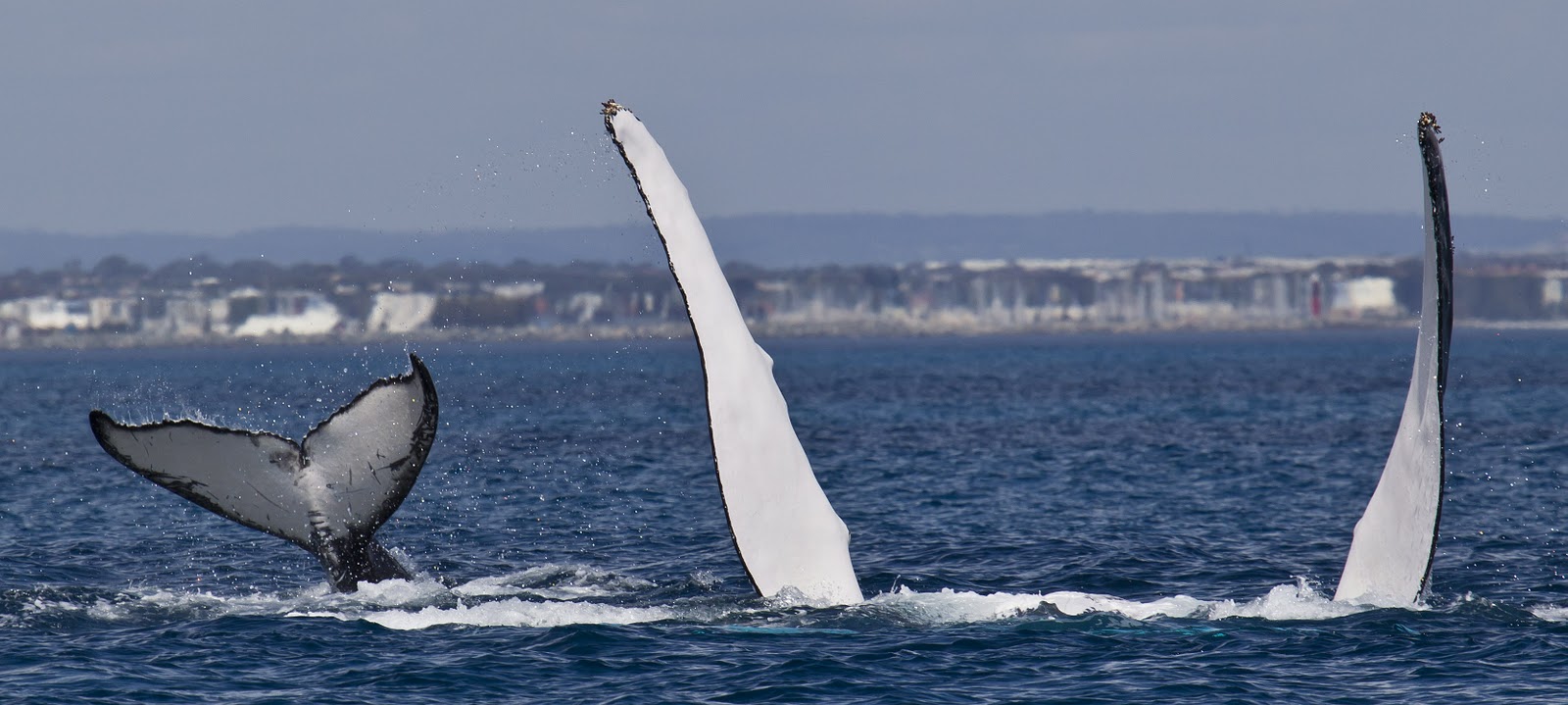
White Fluked Humpback Whale
 |
| A humpback whale flukes up in Exmouth Gulf, Western Australia.
The top fluke surface is usually black. This is the first all white flukes we have seen in
photographing 1480 humpback whales since 2006 in Exmouth Gulf. This image was
taken in October 2011 during the annual southern migration of humpback whales along
the Western Australian coast.
|
Thursday, August 4, 2011
Fins, Flukes & Photographs - Fingerprinting Humpback Whales

A humpback whale calf breaches in the protected waters of Exmouth Gulf, Western Australia.
Next month Pam and I will haul our 6.3 metre Gemini Inflatable 1300 kilometres up the North Western Coastal Highway to Exmouth to photograph the 2011 humpback whale migration and hopefully add another 400 or so whales to the identification catalogue. Each fluke and dorsal fin is different and a unique 'fingerprint' for that whale.
In 2010 we travelled 671 NM on the water and observed 526 whales in 215 pods. After allowing for known re-sights, we saw 483 whales and photographed 444 of them. 164 were new season calves.
We have been travelling to Exmouth each year since 2006. Our first trip was to SCUBA dive and we accidentally stumbled across the best place on the planet to photograph humpback whales - Exmouth Gulf.
From August through to October each year the gulf fills with humpbacks on the southern leg of their migration from the Kimberley to Antarctic waters. They have travelled 1200 kilometres from the Kimberley birthing grounds and calves are about 4 weeks old. The mothers and calves tend to congregate along the western shoreline from Bundegi Reef past the marina, along Pebble Beach and further south.
The shallow north facing waters of Exmouth Gulf provide an ideal rest and respite sanctuary for the world's largest population of humpback whales. Here the calves can rest and build endurance before the arduous journey ahead.
Ningaloo Reef sits just around the corner from Exmouth Gulf. Its inclusion in June 2011 as a World Heritage Area was well deserved but the critical resting areas in Exmouth Gulf were excluded.
New Humpback Babies


The new birthing season for Western Australia's humpback whales is up and running. These images of a mother and new born calf were taken from The Centre for Whale Research (Western Australia) vessel 'Whalesong.'
Whalesong is a new ice capable vessel recently acquired by CWR (WA) and ironically was operating just offshore from the abandoned whaling station Norwegian Bay towards the southern end of Western Australia's Ningaloo Reef. Just as it was when whalers operated from this station, it is an ideal location to observe humpbacks on both the northern and southern legs of their annual migration.
Most humpback calves are born 1200 km further north in the warmer waters of the Kimberley and scientists are concerned that these births may be occurring too early in the migration cycle and incur high mortalities.
In the last few weeks two calves have had to be euthanised after becoming separated from their mothers in Ningaloo's shallow lagoons. Orcas (killer whales) have attacked and taken two other calves. It's a wild ride for the newborns and a sad end for some.
Subscribe to:
Posts (Atom)