
Don't Shoot Me - Humpback Songs of Exmouth Gulf is 2 hours of humpback whale song recorded in Exmouth Gulf, Western Australia by Wayne Osborn. The album is available on iTunes and Spotify. The iTunes links is https://itun.es/au/Tozleb


 |
| A dwarf minke surfaces next to WhaleSong |


 |
| A dwarf minke neatly fitted with a 'limpet' satellite tag. |

 |
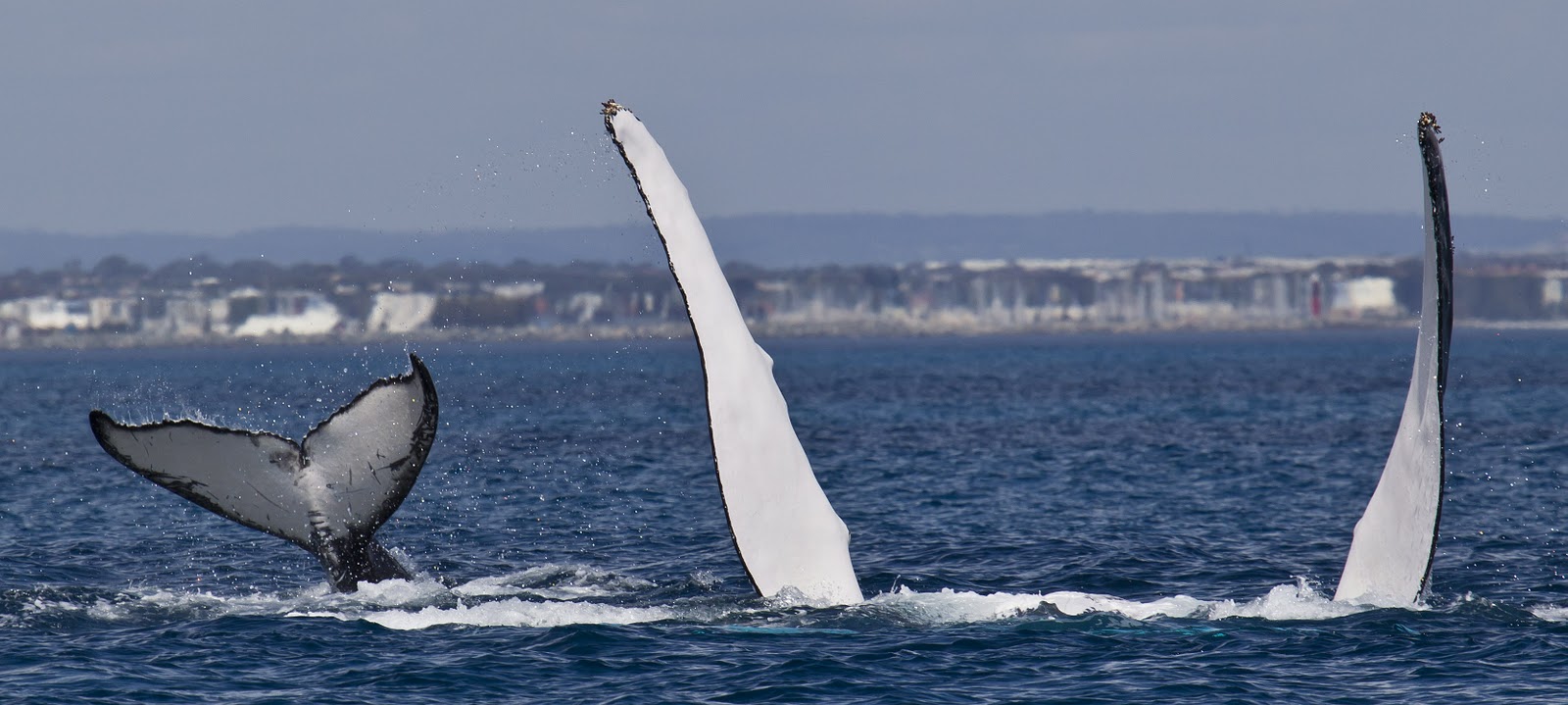
| A humpback whale flukes up in Exmouth Gulf, Western Australia.
The top fluke surface is usually black. This is the first all white flukes we have seen in
photographing 1480 humpback whales since 2006 in Exmouth Gulf. This image was
taken in October 2011 during the annual southern migration of humpback whales along
the Western Australian coast.
|


 I had been following a pod of sperm whales off the north coast of the island of Faial in the Azores and dived with one young male about 6 to 7 metres in length. I saw him again four hours later and as I entered the water, I realized that he was eating something.
 The current edition of Ocean Geographic magazine has run an article of mine on newborn sperm whales in the Azores entitled "Wrinkled Babies." It is issue 13:3/2010 - The Cetacea Edition.

 Bryde's Whales are only an occasional visitor to the Azores. This solitary female spent two days feeding on sardines of the South coast of Pico Island in July.
 On October 26 2009 Pam photographed this humpback north of Rottnest Island, Western Australia during a routine shoot for the Centre for Whale Research's (CWR) humpback catalogue. A large section of the flukes have been excised possibly from a predator attack.
 Above Photograph - Gimme Shelter Book produced from flag expedition.
FLAG EXPEDITION REPORT
PHOTOGRAPHIC IDENTIFICATION SURVEY – HUMPBACK WHALES,
NORTH WEST CAPE – AUSTRALIA (21° S, 114° E)
LEADER: WAYNE OSBORN, FI 04 FLAG ASSIGNED: #150 SEPTEMBER 2009
RESULTS
The expedition spent 13 days on the water between September 10 and 28, 2009. We travelled 462 Nautical Miles in a 6.3 metre rigid inflatable boat, encountered 169 pods, including 417 humpback whales (Megaptera novaeangliae). We photographed 378 individuals including 92 females with newborn calves. This was a pleasing result. During a similar expedition in 2008 we photographed 325 whales.
EXPEDITION BACKGROUND
The waters around North West Cape and the adjacent Exmouth Gulf on the remote Western Australian coastline are an important resting area for the southbound migration of humpback whales. Most birthing activity takes place 700 nautical miles to the northeast in sheltered bays along the Kimberley coastline. The new season’s calves are cautiously chaperoned down the coast under mother’s watchful eye. They have reached the grand age of around 4 weeks by the time they reach North West Cape.
Rugged limestone outcrops form the narrow spine of the Cape Range. Arid coastal plains fringe this outstretched finger of land which terminates at the North West Cape. Exmouth Gulf nestles against the eastern shore and whales following the coastline on their southern migration are swept into the gulf. These sheltered shallow waters provide a safe haven and resting ground. It is an opportunity for the new season calves to build additional blubber reserves and strength for the colder waters further south. Water temperature in the gulf is already 5 degrees C lower from that in the birthing grounds.
Since commercial hunting of humpbacks ceased in 1963, there has been an encouraging recovery from the brink of extinction. It is estimated that only 3.5-5% of the pre-whaling global population remained at that time. The Western Australian population is known as Group D and is now thought to number around 20,000. At this it stage appears to be recovering well from not so recent dark age of whaling.
Apart from some vessel activity due to the port at Exmouth, the area is isolated providing a broad expanse of relatively sheltered water where females can rest their calves before continuing the migration to feeding grounds in Antarctica. Pioneering work on this population has been undertaken since 1990 by Curt & Mich Jenner, founders of the Centre for Whale Research WA (CWR) and has demonstrated the critical nature of resting grounds such as this in the breeding cycle and population recovery.
Accumulation of sound scientific data is important to inform government policy and decision-making. There is pressure for further development of this area to support offshore oil and gas exploration/development and increasing levels of tourism.
The photo-identification database established by CWR underpins the current level of knowledge and provides the authoritative reference for this whale population. Whilst Curt and Mich continually add to the database, the task is enormous, expensive and time consuming.
Private expeditions such as this can play a part in augmenting the database if the work is undertaken in a structured and disciplined manner. For my wife, Pam and myself, it is a rare opportunity to make a modest contribution to a very worthy cause. Our objective was to capture as much field data in the form of photographic images suitable for the database as we could in the time available.
We work under CWR’s research permit which allows for a closer approach to the whales than normally permitted.
FIELD METHODOLOGY
The ideal photographic record includes:
The underside of the flukes and as much of the tailstock as possible.
A left lateral profile of the body including the dorsal.
A right lateral profile of the body including the dorsal.
An underside or ventral view showing the genital area (allows determination of gender).
The photographs should be taken as square on to the body surface as possible.
The ideal is rarely achievable in the field and is highly dependent on animal behavior and sea conditions. We endeavor to capture as much information as we can from each animal against this objective.
Through experience we have found that a combination of Canon’s EOS 1D MkIII body and a Canon L Series 100-400mm image stabilized lens is our preferred workhouse for whale photography. The MkIII’s firing rate of 10 frames per second is excellent for capturing rapid action such a breaches. At f4.5-5.6, the lens is a little slow but we are usually working in bright light, the zoom range gives good flexibility and very good image quality (beyond what may be reasonably expected for such an extreme zoom).
We use 16 GB cards which offer over 1000 images without the need to change cards. Rule 1 of whale photography is that the most interesting behavior occurs when the memory card is being changed. We have found that an ISO setting of 400 and a shutter speed of 1/1600 works well for most situations including breaches. Contrary to many wildlife photographers, we use time value or shutter priority for this work as freezing action is more critical than managing depth of field.
Single point autofocus is also important. Multiple point autofocus is too easily distracted by sea conditions. We also let the auto focus track the subject. The 1D MkIII will usually pull focus on the second frame of a breach if it misses the first.
We also use a Nikon D3 with a 70-200mm f2.8 VR lens for closer work and late light. We started out using a prime 300 mm f2.8 VR Lens on Nikon bodies but it has failed us twice now whilst far from home on whale expeditions. Sorry Mr Nikon but it has been an expensive exercise and my manual focus skills are just not up to the job any more.
A number of underwater images were also taken to supplement the topside work. For this I used a Canon EOS 5D MkII with a 16-35mm Lens in a Nexus housing. This proved to be useful in providing additional images on occasions when whales came close to or under the boat.
A hand held GPS is used to record the day’s track plus waypoints. It is set to record a track point every 30 seconds. The track files are later used to load the GPS coordinates into each image. A waypoint is struck each time a pod is encountered.
My wife Pam does most of the photography. I drive the boat, write the field notes and operate the hydrophone and the second camera when I get a chance. When working with multiple whales, it is important to note which whale flukes at what times so we can tie each image back to a particular animal. This is not always easy and we tend to take a lot of images to capture each animal before and during a dive sequence. A typical days shooting is north of 2000 images and can be up to 3000. All images are taken in RAW to allow flexibility in processing. Over 200 GB of images were taken on this expedition.
We find that it is not worth working once the wind is over 15 knots (over 12 is marginal). The RIB is low to the sea and the ability to track a subject with a telephoto lens is challenging. In addition, the whales are more difficult to approach and less body is out of the water reducing the value of the images.
Approach techniques are particularly important. As this is resting ground for cow and calves, minimizing disturbance to resting and feeding is paramount. We approach slowly and from the side. Whales are more tolerant to a vessel running alongside but crossing closely ahead and behind them creates anxiety.
Once we are in range, we switch off the engine and in many cases the pod will approach us.
BEHAVIORS OBSERVED
Our expedition was timed to coincide with the peak of the Southern migration to North West Cape and Exmouth Gulf. Many of the younger males and females were further south, heading for Antarctica and anxious to end their winter fast.
Cows and calves are often found resting or asleep. During this time they are at particular risk of ship strike, as they lie low in the water with only about 300 mm of dorsal profile showing. It is also not an ideal time for photography with little above surface body as a target. The calves will sometimes lie across their mother’s head to rest.
We observed one ship strike victim. A new season’s calf had a deep one-metre laceration along one flank. On prior visit we have observed whales with dorsals sheared off and a number of other disfigurements.
At other times cows and calves are quite surface active. The mother may breach and the calf will follow suit. Calves can be observed repeatedly breaching and vigorously tail-slapping. Both behaviors are useful for getting photographs of the genital area to determine the calf’s sex.
On three occasions we observed double cow and calf pairs and in each case there was a lot of surface activity taking place. This level of socialization is thought not to be that common however we have also observed this behavior on prior visits.
An escort (or two) may take up with the cow and calf in the hope of a future relationship (the female will not usually mate again until the calf is weaned at around 12 months of age). The escorts are usually keen to prove their value and genetic pedigree with protective behavior, breaching, pectoral slapping and lob-tailing. They may also sing and can be distinctly heard through the boat’s hull if you are close. We recorded several hours of whale song during the expedition and will make this available to researchers.
Mature males were also well represented and keen to mate if the opportunity presented. We observed them in pods of 4 to 8 animals. They we never hard to find as there was always a lot of surface activity where the boys would gather as they raced around at 6-8 knots. Lunging forward on each other, pectoral slapping and breaching were common. Things must get quite physical as the top surfaces of their tubercles (raised protuberances on the head) were often raw and bleeding. We were treated to a number of mock charges and also continued breaching close to our boat. High levels of testosterone obviously have similar behavioral impacts across many species.
A number of whales bore the tell-tale scars of killer whale (Orincus orca) attack. Orca’s are a natural predator and work in concert to wear down and drown humpbacks by gripping flukes and pectoral fins. One mother had significant body scarring but had recovered sufficiently to nurse a healthy new season calf. In the most extreme example, the entire dorsal fin of one whale had been amputated.
IMAGE PROCESSING AND COLLATING
Unfortunately for every hour in the field, there are many more to be spent in front of the keyboard (one small advantage of bad weather).
A folder is created for every pod photographed (e.g. Pod 17 September 21). Each animal is identified according to a code and the type of photograph. This data entered into a master spreadsheet against the photograph file number.
The best indicative images are cropped and converted to black and white, then stored as jpegs. Black and white images are easier to assess when looking to match features, skin textures, scars and pigmentation.
Where the pod is comprised of a cow and calf or a cow, calf and escort, the task of assigning images to a particular animal is relatively straightforward. If the pod is larger and, if there has been a significant amount of fluking activity, life gets more interesting. Details need to be examined to almost a forensic level. Small scars and unique body features are invaluable aids. Of course, if one side of the animal was photographed with the light, the other side will be shot against the light. These images need to be worked hard to get acceptable detail.
A check is made to detect and identify obvious re-sights.
This task is now thankfully completed and the files containing 1,469 images are ready for presentation to the Centre for Whale Research’s Humpback Database.
CWR will use research assistants to digitally classify from the images the following information:
Dorsal – match against 11 profiles.
Body Pigmentation – match against 4 types.
Fluke Pattern – match against 32 types.
Left/Right laterals – divide into 5 sectors and assign against marking and pigmentation guide.
Fluke – divide into 14 sectors and assign against marking and pigmentation guide.
THANKS
To the Explorers Club: It was a delight and privilege to carry flag # 150 into the Australian outback. It has now been well exposed to down-under sunshine, filtered a bit of our ubiquitous red dust, absorbed a sprinkling of the Indian Ocean and inhaled the occasional spray of humpback whale breath.
To Curt and Mich Jenner of CWR: Thank you for the privilege of working under your permit and the opportunity to contribute to the database.
To Pam Osborn: My partner and chief photographer. She has a very good eye and has the camera in hand ready to go every minute we are on the water.
To Denis & Una Glennon: Fellow photographic fetishists who assisted and joined us for part of the trip.
To Wade Hughes: My EC sponsor and lifetime friend.
Wayne Osborn FI 04, October 15 2009


 To preview this book log onto our webpage www.wayneosborn.com.au and go to the Baby Sperm Whale Page.

 Pam and I have completed our 2009 photo-id survey of humpback whales in Exmouth Gulf, Western Australia. We travelled 462 nautical miles, sighted 169 pods and 417 whales during 3 weeks in September. We were able to photograph 378 whales including 92 mothers with calves. The images have been processed and will be added to the Centre for Whale Research's database for this Humpback population.
 This new season Humpback calf has survived what must have been a painful and horrific injury during its first few weeks of life. This one metre gash is the result of a shipping collision - this could have been a recreational or commercial vessel but underpins the need for caution in whale nursery or rest areas. This photograph was taken by Pam Osborn on September 12 in Exmouth Gulf during a photographic survey of the humpback population using the Gulf as a rest area before the long Southern migration to Antarctica.
 A newborn sperm whale suckles from mum. The calf is lying on its side and using the gape of the jaw to feed. Pico Island, Azores

